
Take the Plunge:
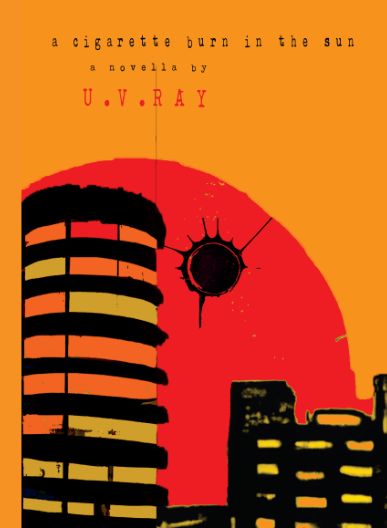
u.v. ray’s a cigarette burn in the sun
Iconoclastic underground writer u.v. ray declared Drug Story (Murder Slim Press 2019) his final book. His readers breathed a sigh of relief when this proved untrue. Two published works—generation zero (Laughing Ronin Press 2022) and a cigarette burn in the sun (Yellow King Press 2023)—followed, the former, a single-story chapbook; the latter, a full novella. The story is worth mentioning here in that it provides insight into the writer’s creative process, particularly his recycling of ideas (identical sentences can be found in both works) in the expansion of short fiction into something longer and broader in scope.
The two pieces are markedly similar. Same place, same time. Birmingham, England. 1986. Thatcher era. The story’s Cheetah Smith toils at a machine producing “those plastic cartons for eggs and sausage rolls,” while the novella’s Angel T. Cooley works at a “meat packinghouse” to pay the rent and support his drug habit. Smith, a drug user himself, quits his job, achieving a measure of peace as he stands on the roof of a building overlooking the city while contemplating a better world wherein “politicians no longer wage wars for you to die in.”
This is where the novella veers from its source material. Cooley, like Smith, quits his job. But this isn’t enough for him. He takes things further, much further. Having told his boss to fuck off earlier in the day, the alienated Goth spends his last hours getting “shitfaced” at a bar called “Loaded” where he prepares his fatal “fuck-off speedball” before vacating the establishment and retreating to a public toilet to depress the plunger.
Cooley’s suicide occurs in the opening pages of the fragmented, nonlinear narrative. The remainder is backstory in which we are introduced to a motley assortment of minor characters. Alcoholics, addicts, dealers, abused cocktail waitresses, scam artists and statutory rapists abound in ray’s universe, all of them engaging in lively Tarantinoesque dialogue. These exchanges, rendered in an eccentric style more aligned with dramatic writing than prose, provide pitch black comic relief to an otherwise excruciatingly grim tale.
Skin Levine is the most prominent of these secondary players as he discovers Cooley’s body while scoring drugs in the public lavatory. He feels bad for the kid, yet still riffles the corpse for anything of value, finding a Pentax camera and a suicide note. Skin sells the camera and torches the note, though not before reading it in its entirety in what is surely the novella’s most powerful scene.
Those familiar with ray’s work will find his signature oscillation between neo noir action and protracted, stream of consciousness rants raging against conventionality in all its forms. His most memorable characters share a singular contrarian ethos; they seek solace in drugs and community in bars and clubs to escape the drudgery of their lives. ray’s is a bleak landscape from beginning to end, a deliberately static, unrelentingly realistic plunge into the urban abyss. a cigarette burn in the sun is a testament to artistic integrity and bravery, a no holds barred, ultra-stylized portrayal of outsiders wading through the existential slime.
 Horror Sleaze Trash