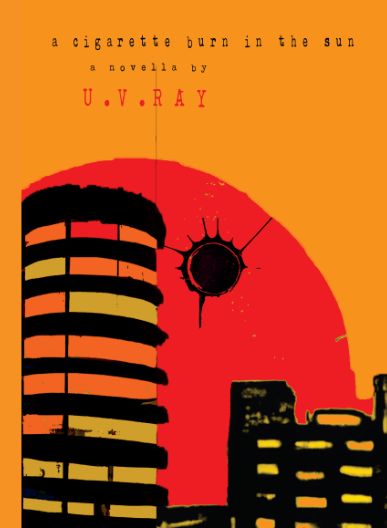
A Cigarette Burn In The Sun, By U.V. Ray

It’s a dismal post-punk Birmingham City, England, 1986. A little over twenty-four hours after the Sigue Sigue Sputnik gig at the Powerhouse Ballroom, twenty-eight year old loner goth kid, Angel T. Cooley crisscrosses a lethal dose of heroin and speed down in a subway at three in the a.m…

In the streets above him, other broken souls who in some way came into contact with Angel continue to swim the murky, muddled waters of their own wrecked lives.

Breaking conventional literary structures, A Cigarette Burn in the Sun is a series of non-linear vignettes that depict a looking glass world where the derelict lives of an array of characters converge without any resolutions to the worthlessness of their own morbid existence, where the futures they dreamed of did not materialise.

What readers have said about u.v.ray:

“Nihilistic, hard-edged, no holds barred”

“Left field outsider philosophy, unapologetic, visceral”

“So hard-boiled you could crack a tooth on it, but also with glimpses of poetic beauty”

“u.v.ray has always written like a man hurtling towards his own death”

“Nobody writes about the gutters of working class life like u.v.ray”

“Hidden in the gritty writing there are moments of love, loneliness and tenderness.”

BUY A COPY HERE

William Taylor Jr.

What Every Poem is Trying to Tell You

Over wine the famous old poet 
tells me how all he can think of anymore 
is the fact of his own death.

It dogs him through his waking hours
and keeps him from sleep.

I’m 20 years behind him
and already spend too many hours 
contemplating the looming 
eternity in which I will not exist.

It’s what every poem is trying to tell you.

It’s why we drink and fornicate
and go to church,

why we fall in love with apathetic bartenders
and assign meaning to the alignment of the stars.

It’s why we read Dostoevsky and Camus

and travel to faraway places
with exotic buildings and food,

why we nod to ourselves reassuringly 
when we read that 56 is the new 37

and scour the internet  
for something to make us
bigger and wiser than death,

desperate for any distraction
from the coming dark

and the old poet’s
haunted dreams.

Robert Pettus 

Lean, Hungry, Prowling

Sunday, November Sixth

Hear that Bengal growlin’, mean and angry!” came the slurred, unified chorus from the collected horde. Assorted German meats sizzled on grills innumerable; mac and cheese sat slowly simmering in crock pots. Sticky wet, plastic collapsible tables lined the cracked cobblestone parking lot just east of Gest Street, in the shadow of the titanic, lengthy Longworth Hall—that leaning, rectangular, chalky brick building long-since mostly abandoned other than the sketchy nightclub filling the echoey bones of its bottom floor.

“You want to play flip-cup?” said Fischer. My friend Fischer was a season tickets holder. He had hooked me up with a free ticket to today’s game—the Bengals were going up against the Panthers. Should be a bounce-back game against an inferior opponent after being whipped by the lowly Browns the previous week. 

“Yeah, I’ll play,” I responded. I poured a healthy portion of my can of Miller Lite into the red solo cup, watching the fizzy liquid bubble and pop in its plastic spherical home. I raised the cup, noticing that my hands were shaking visibly. I realized that I was uncomfortable—I was nervous. I didn’t socialize much in those days. I hadn’t been around such a huge crowd in I couldn’t remember how long. I hadn’t played flip-cup since I was in college, and that was ten years ago.

My teammates chugged their beers and flipped their cups. It came down to me; I was the anchor. I glugged, unable to finish the cup in one drink. I downed it in the second and flipped the cup on the second try. It slid across the plastic table, spinning counterclockwise, slippery in the remnant backwash-booze.

We lost.

“How much did you pour in there?” said my teammate, someone I didn’t know.

“About a third of the cup,” I said.

“That’s too much!” she responded “Just pour in a sip. I’m trying to win some games, you know?”

Friday, November Fourth 

Jin lounged atop the steep hill at the bank of the pool near the waterfall. He blinked in the brightly shining sun, feeling lazy. He liked his new enclosure, but he still yearned for freedom. It was an instinctive feeling; he couldn’t help it. It didn’t matter how much he loved his new home; its size was nowhere near adequate. Tigers need miles of land to prowl; crouching, creeping in tall grass, stalking prey—which, though also free to roam endless miles of wild land, never get too comfortable because of the looming presence of that invisible, striped, orange terror—like a killer filled with bloodlust. 

Jin rolled playfully in the grass, his gigantic paws dipping momentarily into the rippling water. Jin was a Malayan Tiger. He wasn’t that big, at least in comparison with other tigers—he only weighed about 200 pounds. His paws were huge, though. He was young; he still had some growing to do. 

Jin lifted himself from his place in the soft dirt and lumbered down the hill to the glass of the enclosure. When he appeared at the edge of that transparent wall perpetuating his enslavement, he looked out at the gawking onlookers, who were now collecting in number since Jin had come close to the glass. The depth of his eyes, which glowed light green, reflected and multiplied off the dirty glass, bouncing away like an army of ocular flying saucers. 

Jin didn’t like all these hairless apes watching him. He wanted to escape. 

Sunday, November Sixth

We were on a hot streak, having won the last four games. The table was drenched in booze and saliva. 

“Yeah!” I shouted after having successfully flipped another cup. I pointed at Fischer: “I’m whipping your ass!” 

“Yeah, yeah,” he said. “It’s about time to head over to the game, anyway. Let’s grab a road beer and start walking. 

“Either of you want a coney?” came an abrupt voice from the crowd.

“I’ll take one,” I said. The soft bun was filled with a hotdog and Cincinnati-chili, with an excessive amount of stringy cheddar cheese serving as its progressively melting, shaggy roof. I ate it in three voracious bites. 

The parking lot was still packed, though the crowd was shifting collectively toward the stadium like a school of jabbering sardines. Welcome to the Jungle, the chosen theme-song of the Cincinnati Bengals, blasted throughout the area. Axl Rose’s screeching, anguished voice sounded similar to someone being eaten alive. 

I wasn’t a big Guns ‘n Roses fan. 

Friday, November Fourth

Jin slept easily that night. Usually, he spent the nighttime hours pacing around like a paranoid psychopath, looking instinctively for something to hunt. He didn’t do that tonight, though—all of the onlookers from the day had exhausted him, both physically and psychologically. He listened to the calming splash of the waterfall as his horizontal chest contracted and retracted. His lips quivered, revealing his massive canines, as he dreamed of stalking a barking deer through the jungle. Saliva dripped from his mouth to the dirt below, encasing an unawares earthworm. 

Sunday, November Sixth 

It was a long walk across the length of the Longworth Hall parking lot. Most people were in elevated spirits, yelling and slapping hands in excitement for the upcoming game. Some, however, had either started drinking too early or gone too hard, too fast. A woman, using two of her unfortunate friends as a crutch, limped nearly unconsciously in the direction opposite the stadium. Vomit was dribbling from her mouth like a polluted stream. 

“Sucks to be her,” I said.

“Yeah, no shit,” responded Fischer, lifting his can and draining most of it in a single gulp. 

Suddenly, we heard screams from up ahead followed by a rapidly developing, frantic scramble. People ran past us, away from the stadium. Terror painted their faces. 

“The fuck?” said Fischer.

We continued ahead, toward the chaos. 

Saturday, November Fifth

During the zoo’s operating hours, while the collected hairless apes stared at him wide-eyed with amazement, Jin noticed a possible point of escape in his enclosure. The potential for freedom! This filled Jin with an almost uncontainable excitement. He paced the circumference of his enclosure obsessively. What sort of prey lay outside, beyond this cage? Obviously, there was no shortage of these hairless apes—Jin would have plenty of them to eat—but he had never tried them before. They didn’t appear very lean. It wasn’t his typical diet; he wasn’t sure he would enjoy it. Jin was an apex predator—he had the right to enjoy his meals. He had eaten an orangutan once—back in Borneo, but he wasn’t a fan. The hairless apes might be tastier, though. He decided he would give it a shot if he had to. 

The hole in his enclosure—a tear in the fencing near the waterfall—seemed to grow bigger as the day progressed. Jin could hardly wait to try and slip through it—he had seen so many squirrels and chipmunks dart through so carelessly—but he knew he would have to wait until the zoo closed. If he escaped now, they would overwhelm him, these innumerable hairless apes. He needed to wait until they all left.

Sunday, November Sixth 

“The hell?” I said, my voice quivering, stuck in the anxious, fearful shakiness of my throat. People stumbled by, running frantically away. One of them tripped and fell to the cobblestone ground before rising and darting off. Another, covered in blood, limped past. He was clutching at his belly, which was ripped to shreds, as if to cradle his intestines, which dangled outward like a freshly produced rope of sausage. 

“Go!” said Fischer, turning around, “Let’s get the fuck out of here, man!”

Saturday Night, November Fifth 

It was so easy! Even simpler than Jin had expected. He slid right through the rift in the fence, sneaking unseen into the night. This was such a strange place. It reminded Jin a little of Bintulu—the only other commune of hairless apes he had ever freely-traversed—and he hated that place. Those were the apes that had captured him—the apes that had sent him to this strange new place. Jin wished he had eaten one of them, back in Bintulu. At least then he would have gotten some payback; at least then he would know what they tasted like. 

The outside world was dark other than the hanging lights lining the stone paths. Jin, traveling so quickly and unseen as only a tiger is capable, made his way down a large hill, through a maze of stone, eventually glimpsing in the distance a large, softly flowing river. 

“That’s where I’ll find something good to eat,” thought Jin, “A nice fish. Maybe a deer. I may not have to eat those disgusting apes, after all.”

Approaching the river, Jin noticed the sun beginning to ascend. When the sun rose, all the apes came out—Jin knew that for a fact. He had to find a place to hide—to wait out the daylight hours. He was so hungry, but he would likely have to wait until the following evening to find a decent meal. Lumbering into a long, abandoned red building, Jin crouched in a dusty corner and waited. His eyes glowed, shining through the ever-decreasing darkness. 

Sunday Afternoon, November Sixth 

Fischer and I sprinted away from the source of the chaos. We had nearly made it out of the parking lot when I saw suddenly, crawling stealthily out from under a beige Toyota Land Cruiser, a fucking tiger! There was no mistaking it. It’s gigantic paws—its claws protracted and dripping red with fresh blood—gripped the old cobblestone, scraping against the chalky stone as if to sharpen its natural blades; time-tested, evolutionary killing machines.

Sunday Morning, November Sixth 

Jin awoke to a collective, irksome noise coming from outside in the parking lot. It was still relatively dark in his dusty corner, though a glimmer of sun shone through one of the dirty windows high up toward the ceiling of the huge, abandoned room. The adolescent tiger stretched and yawned. He did that every morning; it was a habit. He looked cute—he appeared happy—but he wasn’t. Jin was starving. Though he hated his enslavement at the zoo, they at least kept him well-fed there. They threw chunks of meat at him every day as if he weren’t capable of hunting for himself. He wasn’t used to going long without a bite to eat. Plus, the apes had congregated in number outside the building. He wasn’t sure why so many of them were there—this was more apes gathered in one place than he had ever seen—even including his time in Bintulu. 

“They must be here to get me,” thought Jin. “They must be here to take me back to the zoo. I can’t let them do that.”

Jin was hungry. He decided that he would sneak outside, stalking the apes to see what was going on. That wouldn’t be difficult at all; he knew that. The hairless apes, as innumerable as they were, could be bafflingly clueless creatures. They had no idea what was going on around them. They were more helpless even than typical prey. At least deer listened to their surroundings. They used their ears. These apes didn’t even do that; they behaved like predators though with the strength of prey. Jin hoped they tasted good, at least. 

He snuck quietly out of the building—sliding under one of the numerous cars and crawling on his belly as silently as the ghost of a soldier—through the parking lot. Staring out from his place under a truck he saw a large group of apes. They were yelling at one another; slapping and pushing each other like apes always do. Singing, dancing, and eating their strange, fire-blackened ape food. 

Jin didn’t waste any time. He leapt out from under the truck, jumping high into the air and descending onto a large male. Jin sank his teeth into his neck, sending him instantly, silently, to the stone ground as blood spurted geyser-like and pooled around him. 

Chaos erupted. That didn’t bother Jin, though—that’s what prey animals always did. If you took one of them, the rest would lose their minds. One of them didn’t, though. That one—some overly confident, adolescent stag—perhaps the son of the large male Jin had selected as prey—attacked Jin, swinging his fists down onto Jin’s head as if to bludgeon him. Apes always did that, too; it didn’t hurt Jin. After that, though, the adolescent began pressing his fingers into Jin’s eyeballs. That really angered Jin, who immediately leapt into the young ape, tearing into his stomach—ripping out his organs. The stag, mortally injured, fled. Jin then went back to his meal—the large ape. Jin was so hungry. 

Jin tore into the male’s chest, crunching and splitting the ape’s weak bones. Jin wondered how he had survived for so long, being so fatty and brittle. There must not be any predators in this place; that was good for Jin. He would move in—every place requires an apex predator, if it doesn’t have one, prey become overpopulated. The ape population required curbing—Jin could provide that.

Surprisingly, Jin enjoyed the taste of the hairless apes. They were overly fatty, true, but the meat was tender—the organs were chewy. Still digging into the large male, Jin heard abruptly a loud pop coming from the other direction. He had heard that sound before, back in Bintulu. It wasn’t a good sound. Jin ran from his half-finished meal across the cobblestone parking lot. Hairless apes innumerable dove out of Jin’s path, scrambling in a panic to get away from him. Jin needed to hide. Those pops were never a good thing for tigers. Jin saw another large vehicle. He crept underneath, seeking shelter from the pops. 

Sunday Afternoon, November Sixth 

With a roar, the tiger leapt at Fischer, digging into his calf, sending him collapsing to the ground. Only an instant later—while Fischer was still conscious, while he was still struggling to escape—the tiger drug him effortlessly beneath a Land Cruiser. The vehicle lurched and rumbled as if sputtering from engine malfunction, though it was actually from the jerking movement of Fischer fighting for his life while the tiger tore into him. The SUV’s movement soon stopped. The tiger didn’t reemerge. 

From behind, I heard another gunshot. It was the third one, I thought. I wasn’t sure whether it was someone coming for the tiger, or if looters had taken advantage of the chaos and disorder. I backed away from the SUV. I knew I should try and save Fischer, but what could I do against a fucking tiger? Nothing—that’s what I could do. I didn’t have a gun. I didn’t have a knife, or anything I could really use as a weapon. What would I do, punch it? Hell no. I felt awful, but I backed away, eventually turning into an anxious sprint. I was no match for a predator of that size. That’s what prey did—escaped. That’s what I needed to do. That’s what I did. 

***

Joe Mixon scored five touchdowns in a Bengals route. The bloody, body-strewn parking lot somehow didn’t delay the game. The police, in a later statement, said that if they had postponed the game, it would likely have only added to the chaos. 

Jin was never found, but there’s no way he could have survived for very long. Tigers can’t handle a Midwestern winter, can they? 

That’s what I tell myself. I still avoid crowds, now—just in case.

Karl Koweski

a mustache of cosmic proportions

the mustache
lounging across my upper lip
like a saucy sasquatch
reclining on a beach chair
on the edge of the sea 
of serendipity
is only an accessory
to my grooviness.
it is not an entity
in and of itself as
it is totally subjugated
to my will.
it goes where I tell it to go.

now, there are those
for whom the mustache
dominates the conversation,
becomes the focal point
of a lame existence,
and what a weak group
of limp-wristed hipsters
they must be
to find themselves
so easily over-ruled
by a few thin wisps of hair
perched beneath their nostrils
like weathered tinsel.

over the years,
my mustache has been described 
as “transgressive,” “Sam Elliotian,”
often times, “discombobulated.”
and because of its 
vaunted position,
the mustache receives
more massages than any
other mustache that has
ever existed with
the possible exception
of “Bucky,”
the churlish mustache
which once belonged to
the legendary John Holmes.
but I can write here
with all the humility
a man with the perfect
mustache can muster,
my mustache is larger
and thicker than John
Holmes’ sleazy caterpillar
ever was which is all
that women have ever
really cared about anyway.

I write this now,
an ode to the old
Warsaw Wazoo,
the mustache which 
defended my health
through the entire
CoVid crisis.
I salute you even
as I refuse to
allow you to define
me any further
than as a subject
to one more epic poem.

Rebecca Fletcher

Boss Burrito, Naked Like My Yearning

I wish I could put my arms around your neck, like those aprons you’re so fond of, snug around the back of you, close but not suffocating. I always stand too close, people tell me, but for you I’ll keep my distance, try to make sure you’re comfortable.

I really like spending time with you.

And I know it’s not like the other people, the being too close. We’re not even in the same town. That’s why I follow you online instead, why I know this week you’re celebrating. I sit staring at the photographs, complete with foil taco-shaped balloons declaring ‘Taco bout a party’. I try and peer around them to see what else I could know about you, see who you’re with, to no avail. 

Is there anything sadder than watching a party you weren’t invited to, hoping someone is going to tap you on the shoulder and say ‘Why aren’t you here yet?’ Then I could laugh and put some shoes on and go be part of the fun. The closest I can get to you now is zooming in, but that’s just letting me get closer to the things I can’t reach.

Like you, my precious Taco Bell.

I go to your website and browse out the menu. I don’t like doing it, it makes what we have feel so transactional. I’m greeted with the Naked Chicken Taco, the kind of abomination I want to get my hands dirty with. I wonder if it’s actually crunchy, or if it’s that soft crumbed chicken that melts in your mouth instead. I study the pictures carefully, wondering what I would order if I could go. Right now the Boss Burrito looks amazing, but I know I have days where the Crunchwrap Supreme would be the answer to my problems.

I find videos on YouTube. I see the worker who licked a stacked pile of taco shells and got caught on camera, and I get it. Imagine soft tongues on rough shells, the heady scent of Taco Bell taco shells right up against your nose, mixed with heat and the scent of saliva, like a passionate, stolen kiss in a supply closet. I briefly watch the video fallout to that incident, news presenters with staid tones, and I’m bored by the bureaucracy. Bored by the drama. Angry at people who went to Taco Bell and complained about things that didn’t happen, instead of savouring the things that did.

I lie in bed at night, thinking about what I would do if I could sneak into the kitchen when no one else was there. I think about burying my hands deep into the guac trays, cold, protein-rich sludge sinking between my fingers and under my nails. I think of leaning on flat palms in the metal bean containers, feeling their fragile little skins give way under my hands, spilling their pulpy innards into a muck that I squash against the bottom of the tray as my hand slides across the yielding metal surface. Floury fingers from tortillas. Stolen moments with crispy grilled cheese that stayed too long on the cooktop, browned crusty forbidden snacks. Even the drinks fridge is alluring, bright lights flickering like batting eyelashes.

Can a kitchen flirt?

I wonder if they’d understand why I did it, why it was better that I go to the kitchen when no one else was there, keep my sins to myself, rather than sneak in while it was open and full of people and let them see what you do to me, and the inverse. Instead, this lustful night-time orgy of touch and smell, even though everything would be tainted by the weird, muted dusty smell of refrigeration, is just one more step into the alienation. I wonder how long I would need to leave things out of the fridge to feel them at room temperature, closer to the heat of a living thing? Would it be the same if I microwaved them? I’m sure they have microwaves in their kitchens, even if they barely use them. I wonder how many Cheesy Swirls I can microwave at once, and what I’ll do with them when they’re all ready, warm enough to eat, but not hot enough to burn me. Or maybe they will be, and that can be the punishment for my transgressions.

Maybe I’ll eat them as I rest on piles of crushed taco shells, crumbled into tiny sharp points for me to kneel on as I eat my stolen bounty. The pain will remind me that what I’m doing is wrong, that in another world I could have been lining up at the front counter, mulling over my order, changing my mind as each person in front of me was served. Maybe the toughest choice would have been deciding when it was worth the extra $2 for guac (of course it is). Instead I’m sitting here, in my mind, bare legs on crushed tacos in the kitchen of an abandoned restaurant, hands full of bread wrapped in cheese, juices running down my hands. 

Until then, it’s just a screen between us as I move my finger across my phone, stroking you away and back to me, pinching you to bring you closer.

Alan Catlin

Half Way to Hades

“What would the prophet say if he
saw you in a place like this?”
“Pour me one.”

Philip K. Dick

She promised him “a fucking
week of Christmas in hell,” 
but could only manage a few days
of cooking voodoo chili so hot 
their dreams were soaked with 
sweat and blood, sheets torn into
strips for open wounds they nursed on
like succulents, passion fruits
from lands so distant they might
no longer exist.  Nights, after hours
of rough sex, they licked the desert
heat from the short hairs on their
necks, sipping liquid fire from 
the broken neck of Mescal Gusano
Azul, drinking Tecate from chests
half full of chips of dry ice, mist
rising from within to form circles
around the holes between clouds
where a full moon burned,
“I’ll be your Maximilian, if you’ll
be my Carlota.” He said, in the collective
voices of all the no-longer-conscious 
men they’d left behind along the road
they’d traveled of dancing dust devils 
and death, “Shit, man, you take a girl
our for an ice cream sundae and end up
half way to Hades.”
All, the way, he thought, and then some.

Sean Bronson

Already Human

I remember Audrey’s blue jeans hanging really low off her waist. So low, in fact, the streetlight casts a shadow on her naked pelvic bone. That was right before her body just shut off, and she passed out right on the sidewalk. It happened in a matter of seconds, but the first sign that showed me something was about to happen was when her head tilted back. The fur scarf hanging over her pullover falls and her with it, her head knocking against the pavement. Not being in a right state of mind myself, I don’t even try to catch her. I’m so out of it, her falling loops around in my head a couple of times before the logical side of my brain finally catches, and I realize I gotta do something. So I get on my knees, and for a brief few minutes I have the clarity to check her pulse which is faint but there beating steadily like the stars shining in the middle of the forest without any light pollution to drown out the sky. As I’m feeling around her skull for any cuts, my hands must’ve caught against her quartz, dreamcatcher necklace because clattering is heard, and I see beads rolling off the curb.

We had been waiting in line to see a special art exhibit featuring a live musical performance when the drug hit us like a semi-truck. In the car, parked about a mile away in an open lot, we had pulled out these funky-smelling, dried up roots of a plant and were studying them in the palm of my hand. I had gotten them from a strange-looking dude in the city square one night. It was a part of town where all the cool, grungy people hung out, selling their respective wares of tie-dye shirts, home-made jewelry and, of course, drugs. The particular guy I had gotten the roots from was a very thin, old, white guy who called himself, “The Shaman.” He wore a light blue hoodie and a Scottish-skirt-looking thing for pants. He was mumbling something about gold coming down like rain, and I wasn’t sure if he was trying to give me directions on how to take the thing or if he was zoning out on his own supply. At the end of our meeting, “The Shaman,” waved his hand all around me like he was blessing me or cursing me. I couldn’t tell the difference. He was muttering seemingly made up gibberish with such a mix of aggression and sensitivity that I seriously had second thoughts about doing them as I walked away from the crowd.

I didn’t tell all this to Audrey as we sat in the car. The art exhibit was her idea. I was and am still not an art guy. Drugs were my art you could say. It just made everything more colorful and interesting. Anyway, she wasn’t wholly new to taking stuff, but she was looking at the thing and was seriously having doubts. But I was taking a long time, deciding whether to take them or not. In the end, with music bumping inside the car, I just popped them inside my mouth without warning, and that was how this whole crazy thing began.

We finally both began to “sober” up just as the line to get into the art exhibit started to move. The exhibit was inside of a multi-level parking structure and the now-moving line was wrapped around the building. I thought for a moment maybe we should ditch the thing since we were still in no condition to be looking at framed paintings on a wall. That was my thinking as I slapped Audrey on the cheeks to bring her back into waking consciousness. Her eyes rolled back into place, and her breathing became sudden as if the lungs were in full operation again. With her arm around my shoulder, I was helping her walk down the sidewalk, past the people in line when she mumbled where we were going.

“Home,” I said.

Audrey garbled some kind of response. She was conscious now but still high—as was I. But I could make out that she wanted to go in with the moving line.

“No,” I said.

We got into a little heated argument out in front of the multi-level parking structure with all the people in line staring at us. Thinking back on it now, we must’ve looked like possessed ghouls, muttering incoherent words like grunts somehow getting our words across to one another. A big-bellied guy with a white goatee came over to us then and asked if we were okay. He gave us some cold Gatorade in an unnaturally blue color which I had to pour into Audrey’s mouth like I was pouring coolant into the lips of a radiator.

He sat us down on the curb as the line continued to move. I swore I could’ve heard him say to someone behind in line to go inside without him and that he would meet them inside. Things started to get hazy after that. Time started to fast forward, or maybe, skip forward, at least in my memory. All of a sudden, we were walking down the ramp of the parking structure with parking attendants waving blinking, red batons, waving us to go down. I don’t even know what happened to the big-bellied guy with the goatee. The next thing I remember is reaching the bottom floor where it’s completely flat and a bunch of people are continuing to file in from the ramp. The lights are hot and bright at first. Then, it’s dark save for the blinking red batons which appear as if they’re floating in the black air. A single, distorted guitar string is strummed. Then, whole chords ring through a crowd as bluish-white spotlights shine down on the band playing on stage. I’m still holding Audrey by the waist while she has hers around my shoulder. She’s able to stand on her feet now, but she’s still a little wobbly. Then, wet things start falling on our heads. For some reason, I just accept this fact without even considering that we were in an enclosed space, so rain should’ve been impossible. But I just accepted it—as did Audrey.

The band continued playing, the lead singer’s voice raspy like it was an organic, human, distorted guitar. I don’t know what I mean by this, but that was what I was thinking at the time. We cover our heads with our hands to shade us from the rain, but it’s obvious it isn’t helping because we are getting drenched. Puddles are starting to form under our feet. Drums are being pounced on on stage. A guitar riff flies fitfully through the sky as the singer repeats the chorus. Clouds smolder in the sky.

The songs stops. Music stops. But the rain comes down in a torrential rainfall. The water which was slapping against our drenched shoes is now up to our necks, and on the surface of the water is a wooden ship. Someone’s thrown overboard. Time skips forward again, and I’m standing in front of a cashier at a coffee shop who’s staring with this dumbfounded look in her eyes.

“What size, sir?”

“Tall,” I say.

I don’t remember paying for the coffee, much less actually getting the coffee. I know my memory of that time is completely messed up because, after that, I recall looking up at a framed painting on a matcha-green wall. So, I must be mis-remembering or re-ordering the chronological chain of events. However, in my brain, it’s placed here for some reason. All the planets are spaced together around an invisible sphere. I don’t know about constellations and stuff, but I do know Saturn isn’t bigger than the sun which is how it’s depicted in the painting. The piece after that is of a woman reading a book at the beach, laying on a chair, under the shade of an umbrella. She is nude on top. After that, I remember looking at a black and white photograph of black people in suits and dresses entering into a church.

The last thing I remember, and I swear, I felt like this was really happening. I heard thunder. Lots of it, and I realized it was really bombs exploding. They felt really near. I didn’t look back to see what it was. It was that close. People were running past us. I was still holding up Audrey by the waist who still couldn’t walk properly and kept stumbling. The people running past us I began to make out because they were so different from each other: a small, dark, Asian girl; a beautiful blonde white woman; and a lanky soldier in a World War Two officer’s uniform. At the end of the dusty yellow road, some guy was waving people through a doorway. But the doorway was crooked as if my head was tilted to the side, and the man had a long white beard and a long flowing robe like a wizard.

Salvatore Difalco

H₂S Blues

One night, a horrible stench awoke Sam from a deep sleep. He glanced over at Claudette and assumed it was her and had a hard time falling back asleep the smell was so bad. He awoke the next day slightly put off, indeed hating Claudette a little. Though she was no more or less flatulent than anyone else, she had never passed wind that smelled so awful. Was it a precursor of things to come? 

On another night, Claudette was awoken by a stench so terrible she thought she might puke. She covered her nose and mouth and glanced at Sam. She felt like punching him in the face. She couldn’t fall back asleep, and was so disgusted she wouldn’t talk to Sam for the next two days. 

Neither came forward to discuss their concerns. Then one night both were awoken by a familiar stench—that one, that horrific stench they had both experienced. 

“Was that you?” Sam asked, his eyes watering. 

“Me?” Claudette exclaimed, pinching her nose. “You thought that was me? I would have left me if that was.” 

After a pause they both burst into laughter. 

“You mean to tell me that it wasn’t you?” Sam said, holding his belly.

“No,” Claudette said, snorting with laughter, “I thought it was you!” 

They both laughed until their abdominal muscles ached. Then they lay there in silence, both looking up at the popcorn ceiling.